
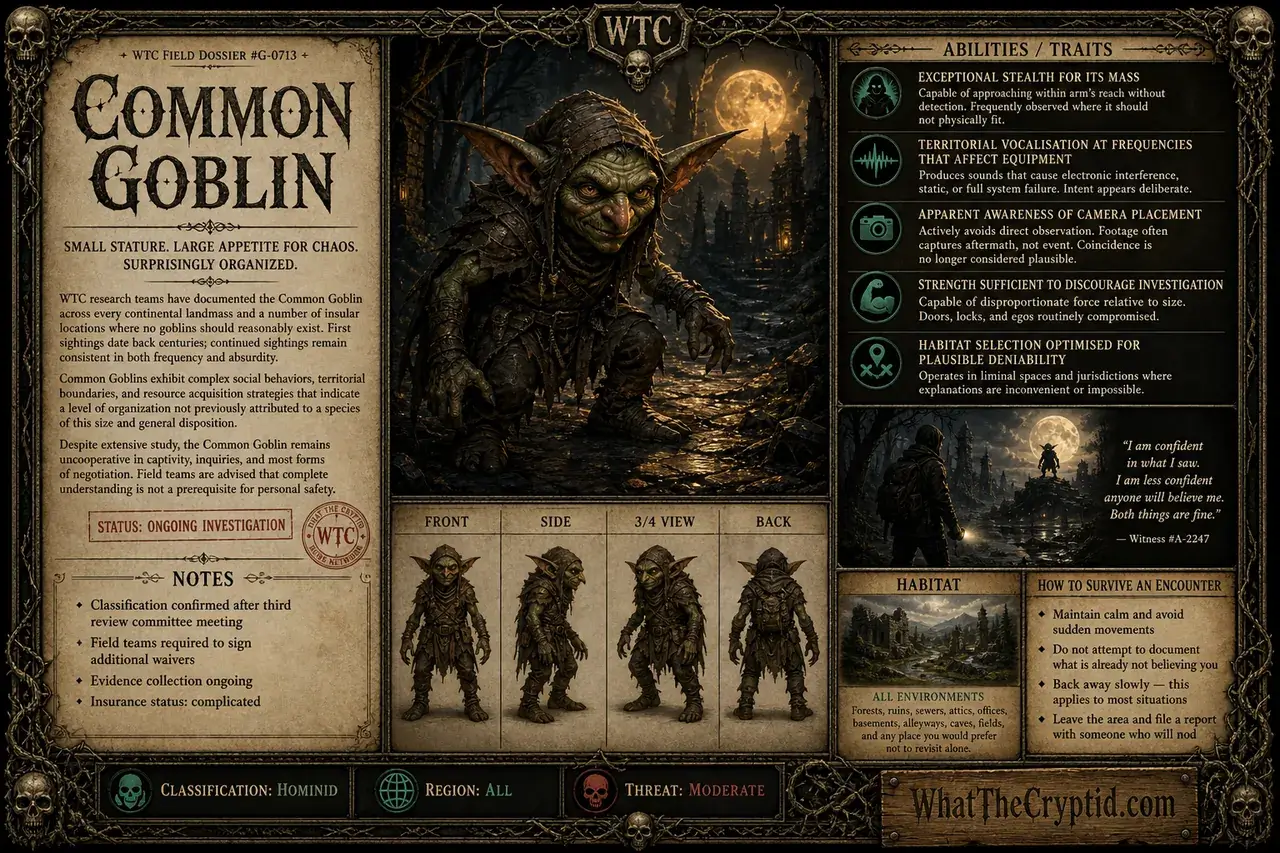
Common Goblin
Small. Territorial. Has strong opinions about your pantry.
Europe
Active
HominidEuropeDomesticFolkloreActive
Overview
The Common Goblin (colloquial taxonomy: Goblinidae vulgaris) represents one of the most consistently documented hominid-adjacent entities in the WTC database, with a sighting record spanning approximately eleven centuries and no fewer than fourteen distinct European cultural traditions. Averaging between 18 and 36 inches in height depending on regional subspecies, the Common Goblin occupies a behavioural niche best described as aggressively domestic — it does not inhabit wilderness so much as it infiltrates the margins of human settlement and proceeds to make its presence known through a methodical campaign of minor property interference. Whether this constitutes territorial behaviour, opportunistic resource acquisition, or something closer to a personal grievance is a question WTC researchers have been debating since the network’s second editorial meeting.

What distinguishes the Common Goblin from comparable small hominids in the WTC database is the remarkable consistency of its documented behaviour across cultures with no historical contact. A 9th-century Norwegian account of a Nisse souring milk and moving tools describes activity functionally identical to a 17th-century English Boggart report from Lancashire and a 2019 incident in a storage unit in Gdańsk. WTC’s position is that this either reflects a genuinely widespread species with consistent behavioural traits, or a remarkable coincidence that our consulting folklorist has declined to rule out.
Danger Level 4 reflects not physical threat — the Common Goblin has rarely been documented causing direct bodily harm — but the cumulative and occasionally escalating nature of its interference, which has in documented cases progressed from misplaced objects to structural damage to what three separate insurance adjusters have independently described as ‘targeted harassment.’
History & Mythology
The earliest verifiable written reference to what WTC classifies as the Common Goblin appears in the Prose Edda, compiled by Snorri Sturluson circa 1220, which describes the Nisse as a small household spirit capable of both protecting and systematically tormenting its host family depending on the quality of treatment received — specifically, whether a bowl of porridge with butter was left out on Thursday evenings. This is not the most demanding protection arrangement WTC has on record, but it is among the most specific. Parallel accounts emerge in German-speaking regions through the 13th and 14th centuries under the designation Kobold, with behaviour patterns sufficiently similar to suggest either common origin or a species with unusually stable cultural presentation.
The English Boggart tradition provides some of the most detailed early field documentation, particularly the compendium assembled by amateur naturalist John Roby in his 1829 Traditions of Lancashire, which records at least seven distinct Boggart incidents with named households and specific damage inventories. Roby treated his subjects with the seriousness of a property surveyor, which WTC considers the correct approach. The folkloric record darkens somewhat in the late medieval period, with goblin accounts in French and Italian sources describing entities less interested in domestic mischief and more interested in direct confrontation — a regional variant WTC has provisionally classified as the Southern European Aggressive Goblin, pending further review of a grant application that has now been pending for three years.
The 20th century saw a sharp decline in formal documentation, which WTC attributes not to population decrease but to the reclassification of encounters as gas leaks, rodent infestations, and, on at least four occasions, ‘carbon monoxide-related perceptual disturbance.’ This represents, in WTC’s assessment, a significant gap in the evidentiary record that convenience alone does not fully explain.
Physical Description
The Common Goblin presents as a bipedal hominid standing between 18 and 36 inches at full height, with the Northern European subspecies trending toward the upper range and the British Isles variant typically documented at 22 to 28 inches. Build is consistently described as wiry to stocky, with limb proportions notably different from juvenile humans — the arms are longer relative to torso length, and the hands are disproportionately large, a feature that WTC’s consulting anatomist notes would be consistent with an entity that spends considerable time manipulating objects in confined spaces. Skin tone in the documentary record ranges from grey-green to earthy brown, with some Scandinavian accounts describing a weathered reddish complexion consistent with outdoor exposure, despite the species’ predominantly indoor habitat.
The facial structure is where regional variants diverge most significantly. Northern accounts describe a broad, flat nose, oversized ears with notable cartilage development, and eyes ranging from amber to pale yellow, described in multiple independent accounts as reflective under direct light — a tapetum lucidum arrangement that would represent a meaningful adaptation for low-light domestic infiltration. British accounts add prominent brow ridges and, in roughly 40% of documented descriptions, a pointed cap of unclear cultural origin, which WTC has flagged as a detail warranting further investigation and has not yet gotten around to investigating. The Southern European variant presents with sharper features, a more pronounced jaw, and, in several Italian accounts, a visible tooth structure described as ‘too many, poorly arranged,’ which our consulting dental anthropologist noted was ‘not impossible, just impractical.’
Clothing, where described, tends toward functional and apparently self-sourced — rough-woven fabric in muted tones, occasionally supplemented with repurposed domestic materials. Three separate 19th-century English accounts describe leather boots that witnesses were confident did not belong to them.
Behaviour & Temperament
The Common Goblin is predominantly nocturnal, with peak activity documented between 11 PM and 4 AM, a window that maximises undisturbed access to domestic spaces while minimising direct human contact — which the species appears to actively avoid despite its apparent fixation on human habitation. Activity follows a consistent escalation pattern: initial presence is typically announced by minor displacements (tools moved, foodstuffs disturbed, small items relocated to structurally inconvenient locations), followed, if the entity is undisturbed, by more ambitious interventions including knot-tying in hair, systematic cabinet reorganisation, and what multiple witnesses have described as the targeted removal of one specific item from every matching pair of objects in the property. The logic of this last behaviour has not been established.
Social structure appears to be solitary in the vast majority of documented cases. The Common Goblin claims a single territory — typically one building or a small cluster of outbuildings — and defends it against other goblins with a vigour it does not appear to extend to human residents. On the two occasions where WTC field teams have documented evidence of multiple goblins in proximity, both situations resolved within 72 hours through apparent displacement of one entity, and in one case through damage to load-bearing structures that our insurance assessor described as ‘disproportionate to the size of the animals involved.’ The species does not appear to form family units, mate for life, or do anything else that would make it easier to study.
The most extensively documented behavioural trait is the conditional nature of the Common Goblin’s relationship with its host household. Entities that are acknowledged — through food offerings, verbal address, or simply the maintenance of household standards the goblin appears to find acceptable — have been documented engaging in genuinely protective behaviour, including warning vocalisations before structural failures, herding of livestock away from danger, and, in one 1887 Norwegian account, the extinguishing of a kitchen fire by means the reporting family declined to specify. Entities that are ignored, mocked, or subjected to what several accounts describe as ‘the deliberate presentation of a poorly made gift’ escalate their interference to a point that the historical record increasingly describes with the vocabulary of a property dispute.
Habitat & Territory
The Common Goblin demonstrates a strong preference for buildings with age, complexity, and evidence of extended human occupation — farmhouses, mill buildings, old inns, and rural storage structures consistently appear in the sighting record at a rate that suggests active selection rather than opportunistic colonisation. Modern construction is not immune, but urban sightings skew toward older buildings converted for contemporary use, with a particular concentration in structures retaining original foundations, cellars, or accessible crawl spaces. The entity appears to require a territory with multiple levels of concealment: a living space (typically within walls, beneath floors, or in roof voids), a food storage area it can access undetected, and at least one point of external egress. Properties that do not provide all three of these features within a single structure are, in WTC’s experience, not occupied for long.
Geographic range covers most of mainland Europe and the British Isles, with density highest in rural Scandinavia, northern Germany, and the Scottish Highlands — regions that happen to combine old agricultural building stock, low population density, and a cultural tradition of not asking too many questions. Elevation range in documented sightings runs from sea level to approximately 1,400 metres, above which sightings drop sharply, suggesting either a physiological limit or a preference for properties with functioning heating.
Diet & Hunting
The Common Goblin is documented as an opportunistic omnivore with a pronounced preference for calorie-dense, shelf-stable foods — dried grains, cured meats, aged cheeses, root vegetables, and preserved goods feature prominently in accounts that note missing pantry contents alongside other signs of habitation. The entity does not appear to hunt in any conventional sense; its food acquisition strategy relies almost entirely on access to human food stores, a method that is less efficient than predation but carries significantly lower personal risk. Fresh produce is taken less consistently, with accounts noting selective removal of the densest and most nutritious items, which suggests either nutritional awareness or strong personal preference. Both possibilities are, in WTC’s view, concerning for different reasons.
Seasonal variation in foraging behaviour has been noted in several long-term accounts: summer months show reduced food interference, consistent with either decreased energy requirements or access to external food sources that are not being documented. Winter accounts show increased activity and, in colder climates, a marked uptick in proximity to heat sources — fireplaces, bread ovens, and, in more recent sightings, boiler rooms and server racks. The 2019 Gdańsk incident mentioned in WTC’s overview section was originally logged as a rodent problem before the storage unit operator noted that whatever was accessing his food supplies was sorting them by expiration date.
Notable Sightings
Farmer Thomas Eccles of Moston documented a two-year occupation of his grain storage barn in a letter to the Manchester Guardian, describing systematic nightly redistribution of stored oats into configurations his farmhands found structurally implausible, along with the braiding of his horse’s mane into patterns ‘too regular for any natural cause.’ Eccles reported attempting to fumigate the structure in October 1873, after which the interference escalated to include the disassembly of a recently repaired fence and the removal of all iron fittings from the barn’s eastern door. Eccles relocated his grain storage to a different building in November 1873 and reported no further incidents in the new location, noting in a follow-up letter that the original barn ‘seemed content to be left to itself.’
Engineering student Lars Bergström reported to the University of Trondheim’s folklore department that the farmhouse he was renting outside the city had, over a period of six weeks, experienced the systematic displacement of every book from its shelves and their replacement in an order he eventually identified as descending page count. Bergström, to his credit, measured 47 of the relocated volumes before contacting the department. The farmhouse owner, reached for comment, stated that the previous tenant had experienced similar behaviour with vinyl records and that she typically reduced rent by 15% to reflect the situation. The folklore department submitted Bergström’s measurements to a regional journal, where they remain under review as of the most recent WTC database update.
Bed and breakfast operator Siobhán Ó Murchú filed a report with the Clare County Council environmental health office describing a nine-month period of nocturnal kitchen interference at her rural property, including the repeated souring of milk left overnight, the removal of an estimated 3.2 kg of stored dry goods, and on one occasion the complete rearrangement of her cutlery drawer into a configuration she described as ‘better, actually, but not the point.’ Ó Murchú stated that the interference ceased entirely in March 2004 following her adoption of a practice, recommended by a neighbour, of leaving a small bowl of porridge on the kitchen threshold each evening. The environmental health office closed the file under the category of ‘undetermined pest activity.’
Storage facility operator Marek Kowalski contacted WTC directly following six weeks of interference in unit 14 of his facility, which he had originally attributed to rodents until CCTV footage captured an approximately 24-inch bipedal figure reorganising tinned goods by expiration date with what Kowalski described as ‘evident system.’ The footage, recorded at 2:47 AM on a Thursday, shows the entity working methodically for 23 minutes before departing through a ventilation panel it had apparently modified for repeated use. Kowalski reported that the unit in question had not been rented for four months prior to the incident and contained only goods left behind by a previous tenant. He has since rented the unit to a regular customer and reports that the customer has not complained, which he noted may or may not be relevant.
Threat Assessment
The Common Goblin poses a low direct physical threat to adults in good health. Documented physical contact is rare and, where recorded, has consisted of hair-pulling, pinching, and in two cases the deliberate tripping of individuals on stairs — the last of which WTC classifies as a meaningful escalation and the reason this entity’s danger level is not lower. The primary risk profile is cumulative property interference and the psychological effect of sustained, targeted domestic disruption, which three separate mental health professionals consulted by WTC have described as ‘not nothing.’
WTC recommends the following approach for confirmed or suspected Common Goblin occupation: maintain a minimum 1.5-metre clearance around known entry points, particularly at night; do not attempt to block or seal identified access routes without first establishing whether the entity has an alternative egress, as sealed-in goblins have historically performed significantly worse than free-ranging ones; avoid direct verbal mockery or the presentation of gifts described in any folklore tradition as provocative (this includes incomplete pairs of shoes, salt poured in thresholds, and iron objects placed in food storage areas); and consider the porridge protocol documented in the 2004 County Clare sighting, which WTC is not in a position to officially endorse but has noted a statistically interesting correlation with incident reduction. WTC acknowledges that this advice is difficult to act on for individuals who are not certain they have a goblin, and that the process of becoming certain is itself the problem.
WTC Field Notes
The Common Goblin has been in the WTC database longer than several of our current staff members have been employed, and its entry has been revised fourteen times, which is more than any other European hominid and more than WTC’s editor-in-chief considers appropriate for a single entity. The most recent revision was necessitated by the Gdańsk footage, which our technical team spent six weeks analysing before producing a report that confirmed the footage was unaltered and then declined to characterise the subject, citing, and we are quoting directly, ‘a preference for not being the person who writes that down officially.’
Field research on the Common Goblin presents logistical challenges that WTC’s standard equipment inventory was not designed to address. Trail cameras deployed in two suspected habitation sites in 2021 were recovered with their footage intact but their mounting hardware relocated to locations our field team found ‘deliberately inconvenient.’ Audio recording equipment left overnight in the Trondheim farmhouse — revisited as part of a 30-year follow-up the university eventually agreed to fund — captured 4.5 hours of ambient sound, 23 minutes of unidentified movement, and what our audio analyst described as a single exhalation of breath approximately 8 inches from the microphone at 3:12 AM, followed by silence for the remainder of the recording. WTC has not returned to the farmhouse. This is noted here for completeness.