
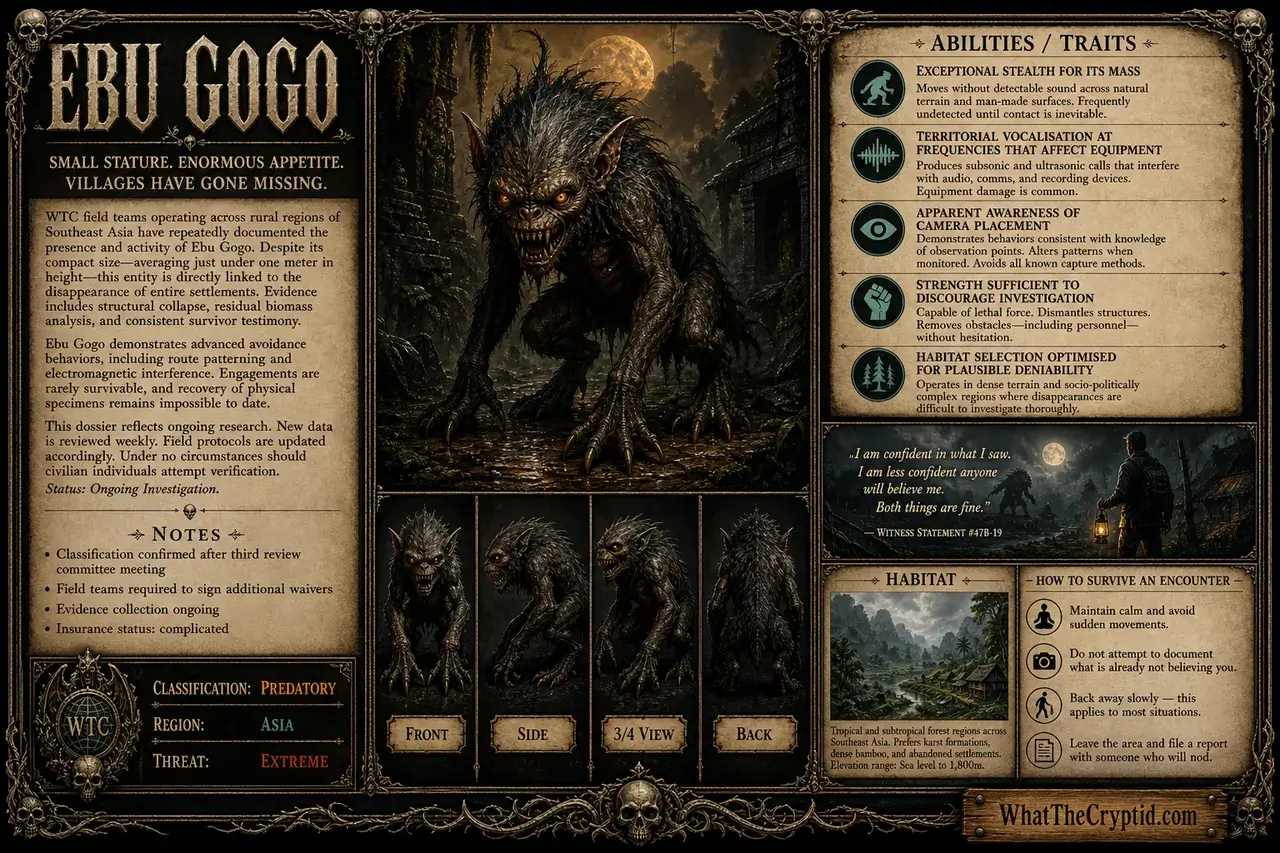
Ebu Gogo
Still hungry. Possibly still there. Definitely still asking.
Asia
Active
HominidIndonesiaFloresRelict Hominin
Overview
The Ebu Gogo are a population of small, bipedal hominids reported primarily on the Indonesian island of Flores, where oral traditions among the Nage people describe them not as legend but as neighbours — specifically, as the kind of neighbours who cannot be trusted around food stores or unattended children. The name translates with reasonable directness as ‘grandmother who eats anything,’ which WTC considers both an efficient introduction and a reasonable basis for a moderate threat rating.

WTC classifies the Ebu Gogo within the broader category of relict hominid — a subset of cryptid for which the physical evidence is, charitably, sparse, but for which the folkloric record demonstrates a specificity and consistency that resists easy dismissal. The Nage do not describe the Ebu Gogo as supernatural. They describe them as small, hungry, and gone — or mostly gone — following a community decision that will be addressed in the History section. The precision of that tradition is something our consulting paleoanthropologist described as ‘professionally inconvenient.’
History & Mythology
Nage oral tradition on Flores places the Ebu Gogo as contemporaries of the human population for an extended and largely unhappy period prior to the seventeenth century, with accounts describing a community dwelling near Liang Bua — a limestone cave system that, as of 2003, is also the discovery site of Homo floresiensis, the archaic hominin species whose skeletal remains date to as recently as 50,000 years before present. WTC notes that this coincidence has not been resolved to anyone’s satisfaction and has generated a volume of academic correspondence that we have been asked not to summarise as ‘a argument.’
According to Nage accounts, the Ebu Gogo were tolerated for generations despite persistent theft of crops and food from communal stores. The arrangement deteriorated when the creatures were observed abducting a human infant, which the Nage elders determined constituted a change in the relationship. The community subsequently lured the population into a cave using palm fibre as bait — the creatures reportedly found it edible — and set the interior alight. Most accounts indicate the population was destroyed in this event. Most accounts also include the detail that one male and one female escaped into the forest. Whether this is a narrative convention or a field observation has not been established, though it is the detail that tends to hold the room at WTC editorial meetings.
Western academic attention arrived formally in 2005, when anthropologists Gregory Forth published analysis of Nage oral traditions alongside the Homo floresiensis discovery, proposing a possible correspondence between the folk record and the fossil record. The paper was peer-reviewed. The reviews were mixed. The Nage had been saying the same thing for three hundred years without requiring peer review.
Physical Description
Documented descriptions across multiple Nage community accounts converge on a standing height of approximately 1 to 1.5 metres, with a build described as broad relative to height and a gait that witnesses consistently characterise as shuffling or rolling rather than striding. Body hair is reported as long, matted, and covering most of the torso, while the hair of the head is described separately as reaching to or below the waist. The face is reported as flat with a notably wide mouth — a detail that recurs across geographically separated accounts with a consistency that WTC’s editorial team found, in aggregate, more compelling than any individual report.
The ears are described as noticeably large and, in several accounts, as moving independently — a detail that WTC has not been able to corroborate through any consulted mammalian biology source but which has also not been definitively ruled out. The abdomen is reported as pendulous, consistent with a high-volume, low-quality diet, and the feet are described in some accounts as reversed — heels forward — which WTC notes is a feature shared with several other Southeast Asian folkloric entities and which our consulting anatomist declined to assess without physical evidence. The voice is described uniformly as a murmuring or babbling sound, occasionally mimicking human speech at proximity, with comprehension unclear and apparently mutual.
Behaviour & Temperament
The Ebu Gogo are described across traditional accounts as operating in small family groups of five to ten individuals, with no clear evidence of formal social hierarchy beyond the apparent authority of elder females — a point the Nage accounts emphasise and which WTC considers relevant to the naming convention. Activity appears primarily crepuscular, with most recorded interactions occurring at dawn or dusk near the edges of agricultural areas. Direct midday encounters are rare in the oral record, suggesting either diurnal avoidance of open terrain or a sleep schedule that the Nage found, if anything, relatable.
The creatures demonstrate what can most accurately be described as opportunistic boldness — not territorial aggression, but the specific and goal-oriented confidence of an entity that has located a food source and is conducting a cost-benefit analysis. Crop theft, food store raids, and the acceptance of offered food are all documented. The Nage tradition records that the Ebu Gogo would repeat back words spoken to them, which some WTC researchers have interpreted as evidence of language acquisition and others have interpreted as evidence of something else entirely. Both groups have been asked to submit their findings in writing.
The infant abduction incident that precipitated the cave burning is treated in Nage tradition as an aberration rather than a pattern, which WTC notes is either reassuring or represents a definitional threshold we would prefer communities not to have established through experience.
Habitat & Territory
The Ebu Gogo are associated specifically with the interior forest and cave systems of Flores Island, Indonesia, at elevations ranging from approximately 500 to 1,200 metres above sea level. The terrain preference is for dense secondary growth adjacent to cultivated land — a habitat selection that reflects the dietary opportunism of the species more accurately than it reflects any particular environmental requirement. The proximity to human settlement is, in this context, a feature rather than an overlap.
Liang Bua cave and the surrounding limestone karst system represent the historically documented core territory. The cave system provides shelter consistent with the nesting patterns described in oral tradition, and the broader Flores interior offers sufficient forest cover to explain the absence of confirmed post-seventeenth-century specimens without requiring their extinction. WTC’s field research coordinator has noted that ‘sufficient forest cover to explain an absence’ is doing a significant amount of work in that sentence.
Diet & Hunting
The Ebu Gogo are described in Nage tradition as consuming essentially anything organic, with documented food sources including crops, root vegetables, raw meat, insects, and, in several accounts, the raw flesh of animals larger than themselves — the mechanics of which are not elaborated upon in the source material. The name’s translation bears repeating here. The individuals who named this species had data.
The detail that the creatures accepted and ate palm fibre — the material used to lure them into the cave — is noted in the oral record without particular emphasis, as though this fell within the expected range of their dietary behaviour rather than outside it. WTC’s consulting nutritionist was asked to comment on the caloric value of raw palm fibre and provided a figure that we have chosen not to include, on the grounds that it raises questions the entry is not structured to answer.
Notable Sightings
Nage community oral record documents repeated interactions with a group of six to eight Ebu Gogo individuals who inhabited the forest margins north of the cave system, with encounters concentrated around harvest periods. The most detailed account describes a village elder offering cooked food to two individuals who approached within three metres of a communal cooking area, accepted the food, and then remained at the edge of the clearing for approximately one hour before departing. The elder’s account, as transmitted through oral tradition, notes that they appeared to be waiting to see if more food would be produced. It was not.
A farmer named Paulus Boa reported encountering a pair of small, hair-covered figures at the edge of his sweet potato field at approximately 05:30 local time, describing them as standing just under his shoulder height and watching him from a distance of roughly eight metres without retreating. Boa noted that the figures appeared more interested in the crop than in him personally, which he considered a meaningful distinction. He returned to his house and did not approach further. When he came back twenty minutes later with his brother, the figures were gone and approximately four kilograms of sweet potatoes had been removed from the nearest row.
A field assistant working with the Australian archaeological team excavating Liang Bua cave — the same team that would weeks later uncover the Homo floresiensis remains — reported hearing sustained vocalisation from the forest canopy above the cave entrance at dusk, described as a low, repetitive murmuring distinct from any known local bird or primate species. The assistant, who has not been named in subsequent documentation, noted that the sound lasted for approximately twelve minutes and ceased when a second team member emerged from the cave mouth. The incident was logged in the site diary as ‘ambient wildlife noise.’ The Homo floresiensis discovery was announced to the scientific community six weeks later.
Anthropologist Budi Santoso, conducting follow-up fieldwork on Nage oral traditions, recorded testimony from an elderly woman who stated that she had seen an Ebu Gogo at the edge of her family’s maize field when she was approximately twelve years old — placing the sighting in the mid-1960s — describing a single female individual who stood watching her for several minutes before retreating into the undergrowth. The witness stated that she had not mentioned this to researchers who visited in the 1990s because, in her assessment, they had not seemed prepared for it. Santoso included this account in his fieldwork notes, which were submitted to his university department and have not been published.
Threat Assessment
WTC assigns the Ebu Gogo a threat rating of Moderate, based on documented behaviour patterns that are opportunistic rather than predatory toward adult humans, with the infant abduction incident representing an elevated-risk scenario that field teams should not dismiss on the grounds that it was historically contingent. Individuals operating in known Ebu Gogo habitat — the interior forests and cave margins of Flores Island, particularly in Ngada and Nagekeo Regencies — are advised to secure food stores at a minimum distance of 50 metres from sleeping areas and to avoid leaving food unattended at dawn or dusk, which the available evidence identifies as peak activity windows.
Direct approach is not recommended at any distance below 15 metres, based on the range at which the creatures have demonstrated awareness of and interest in human presence. Offering food is specifically discouraged, not because it will necessarily produce an aggressive response, but because it will produce a return visit. WTC’s threat guidance is limited by the fact that our most detailed behavioural data predates the seventeenth century, and we acknowledge that this is not an ideal evidence base from which to derive safety protocols.
WTC Field Notes
WTC dispatched a field researcher to Flores in late 2022 with a budget sufficient for a two-week stay, three camera trap units, and a satellite phone that the airline lost in transit. The camera traps were deployed across two sites in the Liang Bua forest margin and returned 847 motion-triggered photographs over eleven days, of which 844 were confirmed as wild boar, two were confirmed as the field researcher retrieving the camera trap units, and one remains under assessment. The researcher’s written report described the atmosphere in the cave system at dusk as ‘not nothing,’ which our editor has asked be revised into language suitable for publication. The revision has not been received.
WTC notes that the convergence of the Ebu Gogo oral tradition with the Homo floresiensis fossil discovery represents the category of evidence that our editorial team finds most professionally difficult — not because it confirms the cryptid’s existence, but because it makes dismissal feel less like scepticism and more like a choice. We have allocated funding for a return field visit in fiscal year 2025, contingent on insurance approval, which is pending review by an assessor who has requested additional context on the cave burning incident.