
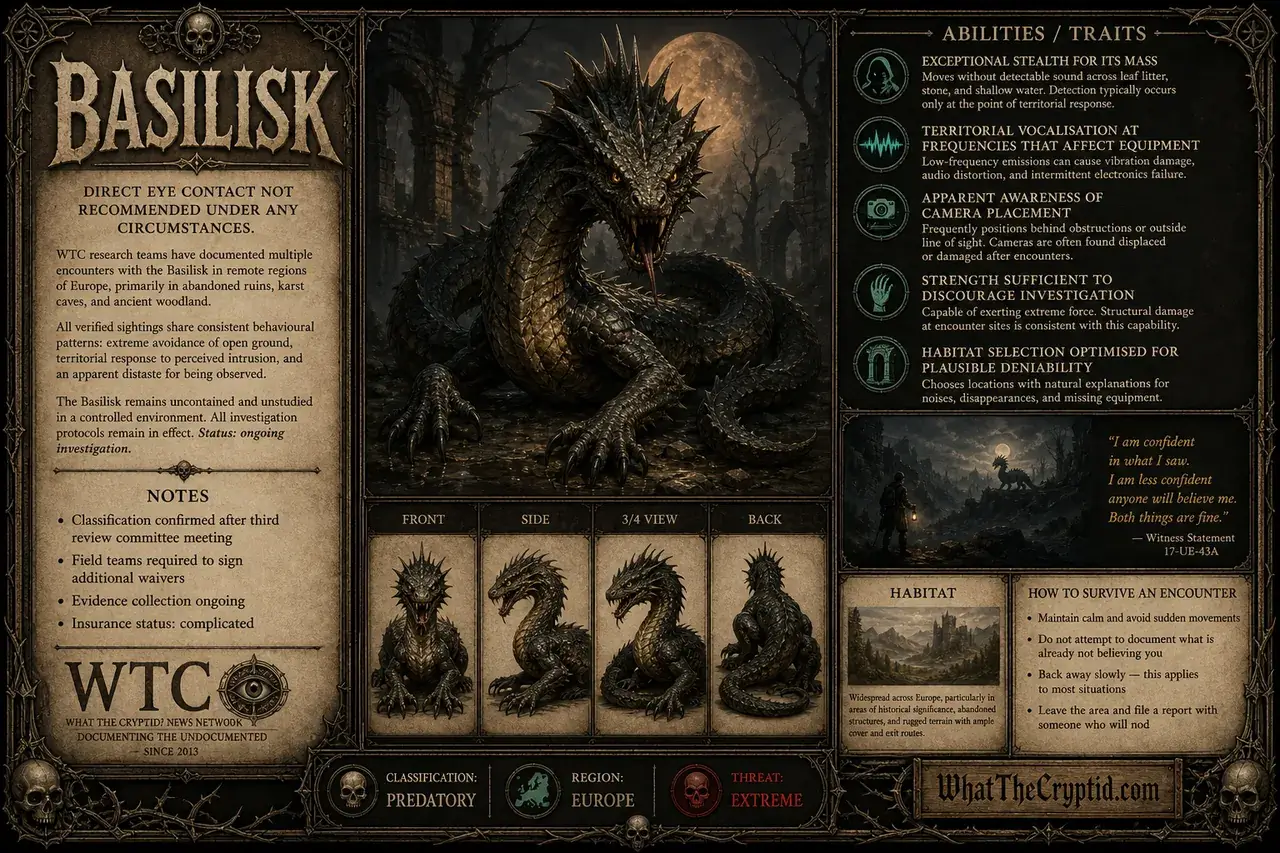
Basilisk
Documented since 77 AD. No surviving eyewitnesses. Draw your own conclusions.
Europe
Unverified
SerpentLethal GazeClassical AntiquityNorth AfricaExtreme Threat
Overview
The Basilisk occupies a singular position in the WTC Cryptid Database as the only entity for which our standard field research protocol — direct observation — is specifically contraindicated by the research itself. Classified as Predatory and assigned a danger level of 10, the Basilisk is a large serpentine cryptid historically distributed across North Africa and Southern Europe, distinguished primarily by a defensive or offensive mechanism that witnesses have described as a lethal visual projection. WTC uses the term ‘witnesses’ loosely here, as the evidentiary record will make clear.

The entity is typically described as a serpent of modest length — estimates range from 6 to 36 inches depending on the source — crowned with a distinctive white marking on its head that classical authors compared to a diadem. What the Basilisk lacks in size, it is said to compensate for comprehensively. Ancient sources attributed to it the capacity to kill vegetation on contact, split stone by proximity, and cause fatal outcomes in humans via direct gaze, breath, or touch. WTC notes that an organism capable of all three would represent a significant departure from known biochemistry, and has referred this question to our consulting biologist, who requested more time.
Modern sightings are sparse relative to the historical record, a pattern that admits of two interpretations. Either the Basilisk population has declined substantially since antiquity, or the evidentiary challenges posed by an entity that kills observers have created a persistent documentation gap. WTC considers both hypotheses live.
History & Mythology
The earliest substantive account of the Basilisk appears in Pliny the Elder’s Naturalis Historia, completed approximately 77 AD, in which Pliny describes the creature as a small serpent native to the Cyrene region of North Africa, capable of killing with its gaze and so venomous that its passage scorches the earth. Pliny’s account is notable for its specificity — he cites a width of twelve finger-breadths and a distinctive crown marking — and for the methodological problem it creates, which is that Pliny does not explain how these measurements were obtained.
Medieval natural historians expanded the Basilisk’s profile considerably, adding the cockerel-hatched-from-a-serpent’s-egg origin story, a variable number of legs depending on the manuscript consulted, and the detail that weasels were the Basilisk’s only natural predator, being immune to its gaze by virtue of consuming rue beforehand. This last claim was considered credible enough to prompt documented instances of medieval pest controllers releasing weasels into suspected Basilisk territories, which WTC acknowledges is a more organised institutional response than we have managed ourselves. The mirror-as-countermeasure theory — that the Basilisk could be killed by its own reflected gaze — appears consistently from the 13th century onward, though the logistics of deploying a mirror against an entity you cannot look at directly have not been satisfactorily addressed in any source we have located.
Historical sightings cluster most heavily in the period between 200 BC and 1400 AD, after which they decline sharply. Whether this represents genuine population collapse, the cessation of weasel deployment programmes, or simply improved editorial standards at European publishing houses is a question WTC has not resolved.
Physical Description
Physical description of the Basilisk varies substantially across centuries and source regions, a fact that WTC records without yet concluding is a problem. The classical model — as described by Pliny, Lucan, and later Isidore of Seville — is a serpent of small to moderate length, typically cited between 6 and 18 inches, with a pale or yellowish body, a distinctive white crown-shaped marking on the dorsal surface of the head, and an upright carriage that classical authors noted was unlike the typical serpent’s ground-level transit. This posture, combined with the crown marking, is presumed to be the origin of the ‘king of serpents’ designation, though WTC notes that the title may also simply reflect the lethality gradient.
Medieval European variants expanded the form considerably. Sources from the 12th through 15th centuries describe a creature combining serpentine and avian features: a rooster’s head and neck, a serpent’s body, and in some illuminated manuscripts, vestigial wings. This is the form conventionally distinguished as the Cockatrice, though the distinction was not consistently maintained by medieval authors and WTC has chosen not to treat them as separate entries at this time. Body length in these accounts ranges up to 36 inches, with weight estimates that are conspicuously absent from the primary sources, suggesting that nobody involved had completed the relevant measurement.
The distinguishing feature across all variants is the crown marking, described consistently as white, pale gold, or faintly luminescent, positioned centrally on the dorsal head and approximating a three-pointed diadem. Several medieval illuminations depict this marking as raised — a crest rather than a coloration — though field confirmation of this detail has not been obtained and is not expected imminently.
Behaviour & Temperament
The Basilisk, if the consolidated historical record is taken as approximate field data, is a predominantly solitary, low-mobility predator that appears to do very little active hunting in the conventional sense. This is consistent with the documented mechanism: an entity that can kill at range by gaze has limited incentive to pursue prey. The behaviour pattern that emerges from classical accounts is one of territorial occupation — the Basilisk establishes a range, typically arid or rocky terrain, and the range becomes and remains uninhabited by most other species. This is, from an ecological standpoint, a highly efficient strategy, and WTC’s consulting ecologist described it as ‘almost unreasonably effective’ before declining to elaborate.
When encountered directly, historical accounts describe the Basilisk as neither fleeing nor displaying territorial aggression in the theatrical sense. It does not rear, spread a hood, or vocalise. It simply orients toward the stimulus. Given the documented outcome of this orientation, the behaviour reads as calm to the point of suggesting the entity is aware that calm is sufficient. Pliny notes that the Basilisk moves in a straight line when traversing open ground, holding its head elevated, and does not deviate to avoid obstacles — a description that suggests either extreme confidence or an organism that has not yet encountered an obstacle it found meaningful.
The weasel predation account, repeated across multiple independent medieval sources, implies that the Basilisk does have at least one natural vulnerability, which WTC finds somewhat reassuring. The mechanism proposed — weasel immunity via dietary rue consumption — has not been tested under controlled conditions, and our field teams have been advised that it will not be tested under controlled conditions involving WTC personnel.
Habitat & Territory
The Basilisk is historically associated with arid, rocky terrain at low to moderate elevation, with the Cyrene region of present-day Libya most frequently cited as the core range in classical sources. Secondary habitat descriptions mention desert margins, cave systems, and ancient ruins — environments sharing the qualities of low human traffic, stone substrate, and limited vegetation, the last of which may be cause rather than consequence of Basilisk presence. Medieval European accounts extend the range northward into Iberia and the Italian peninsula, typically locating the entity in abandoned structures, dry wells, or cellars, which suggests either a range expansion or a population willing to adapt to available real estate.
The consistently noted detail that Basilisk passage desiccates vegetation and renders water sources non-potable implies a habitat impact significant enough to be a reliable secondary indicator of presence. WTC field teams looking for evidence of Basilisk activity are directed to note unusual vegetation die-off, unexplained absence of small mammals and ground-nesting birds, and stones with surface scoring inconsistent with weather exposure. These indicators are, WTC acknowledges, also consistent with several entirely explicable geological and agricultural phenomena, but the overlap is worth documenting.
Diet & Hunting
Dietary information for the Basilisk is among the least well-documented aspects of the entity, a gap that is readily explained by the circumstances under which dietary observation would need to occur. Classical sources confirm that the Basilisk does consume prey — Pliny describes it killing small animals and birds — but the mechanism is described almost entirely in terms of the killing method rather than the consumption. Whether the entity feeds by conventional ingestion, absorbs nutrition from proximity to killed prey, or sustains itself through some mechanism not yet categorised, the sources do not specify with any consistency.
Medieval accounts add the detail that the Basilisk’s primary prey includes small rodents, ground-nesting birds, and on at least three occasions described in hagiographic texts, livestock up to the size of cattle — though the cattle accounts require the Basilisk to have been either larger than classically described or operating in proximity to a very unfortunate field. Water sources within Basilisk territory are described as rendered permanently non-potable, which raises the question of how the entity itself meets hydration requirements. WTC has noted this question in the research log and assigned it a priority rating that reflects our current staffing levels.
Notable Sightings
The earliest formally recorded account, cited by Pliny the Elder in Naturalis Historia, describes a Basilisk encountered by soldiers of the Roman cavalry during operations in the Cyrene region. The animal was reportedly flushed from rocky scrubland during a patrol, and three soldiers were killed before the engagement was broken off. Pliny records the crown marking, the upright posture, and the twelve-finger-breadth body width with the same editorial register he uses for trade winds and olive cultivation. The account was accepted as credible by every major natural historian for the subsequent fourteen centuries, which WTC notes is a longer consensus lifespan than several of our current research conclusions.
The Warsaw Basilisk incident is among the most extensively documented early modern accounts, recorded in civic records and later cited by multiple Polish historians. Two young girls reportedly encountered the entity in a ruined cellar beneath a collapsed building in the city, with both dying within hours of exposure. A local physician, Dr. Benedykt of Kobielski, arranged for a condemned prisoner named Benedykt of Kraków to enter the cellar wearing a suit covered in mirror fragments, on the theory that reflected gaze would prove fatal to the entity. The prisoner emerged reporting a dead serpent approximately 18 inches in length with a pronounced white crown marking. The civic records confirm payment was made to the prisoner’s estate, suggesting that ’emerged alive’ was interpreted with some flexibility.
A monastery chronicle from Castile records the death of a lay brother who encountered an unknown serpent while clearing scrubland on the monastery’s eastern border. The brother survived long enough to report the encounter to the prior, describing an upright serpent ‘with a crown of light upon its head, no larger than a man’s forearm.’ He described no physical contact. Two additional livestock deaths in the same field over the following week prompted the prior to close the eastern boundary and commission a weasel procurement, the outcome of which the chronicle does not record. The eastern boundary remained closed for eleven years.
A gamekeeper named Alastair Drummond reported finding a section of moorland approximately 40 metres in diameter in which all vegetation had died simultaneously and in a radial pattern inconsistent with drought, fire, or pest activity. At the centre of the affected area, Drummond photographed what he described as ‘a large snake, pale, holding itself up off the ground in a way snakes don’t,’ before his dog fled and he chose to follow it. A herpetologist consulted by the local wildlife authority confirmed no native Scottish species matched the description and offered no further comment. Drummond submitted a formal report to the authority, took two weeks of personal leave, and upon returning to work declined all interviewing requests, citing what he described as ‘a preference for not thinking about it.’
Threat Assessment
The Basilisk presents a threat profile that WTC’s standard risk matrix was not designed to accommodate. The primary hazard — lethal visual contact at undetermined range — cannot be mitigated by the distance-based protocols that apply to most Predatory-class entities. Historical sources suggest effective range of the gaze mechanism may extend to several metres, though the upper limit has not been established under conditions that produced surviving data. WTC recommends that personnel operating in documented or suspected Basilisk habitat avoid direct visual engagement with any serpentine organism displaying a white dorsal crown marking, and that approach distances of no less than 15 metres be maintained at all times. WTC acknowledges this recommendation is of limited operational value if the entity is encountered at closer range before identification is confirmed.
The mirror countermeasure documented in medieval accounts should be considered a field option of last resort rather than a reliable protocol. Personnel wishing to carry reflective surfaces into potential Basilisk habitat are not discouraged from doing so; they are simply advised that the 1587 Warsaw incident involved a full-body mirror suit constructed over a period of several days, and that the pocket mirror typically carried in standard WTC field kits represents a different scale of preparation. The Basilisk’s threat rating of Extreme reflects the combination of documented lethality, limited countermeasures, and the structural impossibility of collecting post-incident witness testimony from anyone who has confirmed a sighting at close range.
WTC Field Notes
WTC has been attempting to establish a dedicated Basilisk research programme since 2019, when our North Africa field correspondent submitted a location report for what she described as ‘a promising site with strong secondary indicators’ in the Libyan desert south of Benghazi. The programme has been deferred each quarter due to budget constraints, insurance complications, and an ongoing internal debate about whether ‘direct observation’ should remain a required deliverable for Extreme-rated entities. Our chief underwriter has reviewed the historical record and declined to provide coverage for field personnel conducting primary research on the Basilisk, describing the entity in correspondence as ‘essentially uninsurable.’ This position has been escalated to our board and has not yet been resolved.
In the interim, WTC has contracted two independent classical scholars to conduct a full audit of primary source materials from 77 AD through 1700 AD, with the goal of producing a standardised sighting database that can be analysed for population distribution, habitat patterns, and potential active territories. The audit is ongoing. One of the scholars has requested that their name not appear in any published materials associated with this project, a condition WTC has agreed to without requiring explanation.