
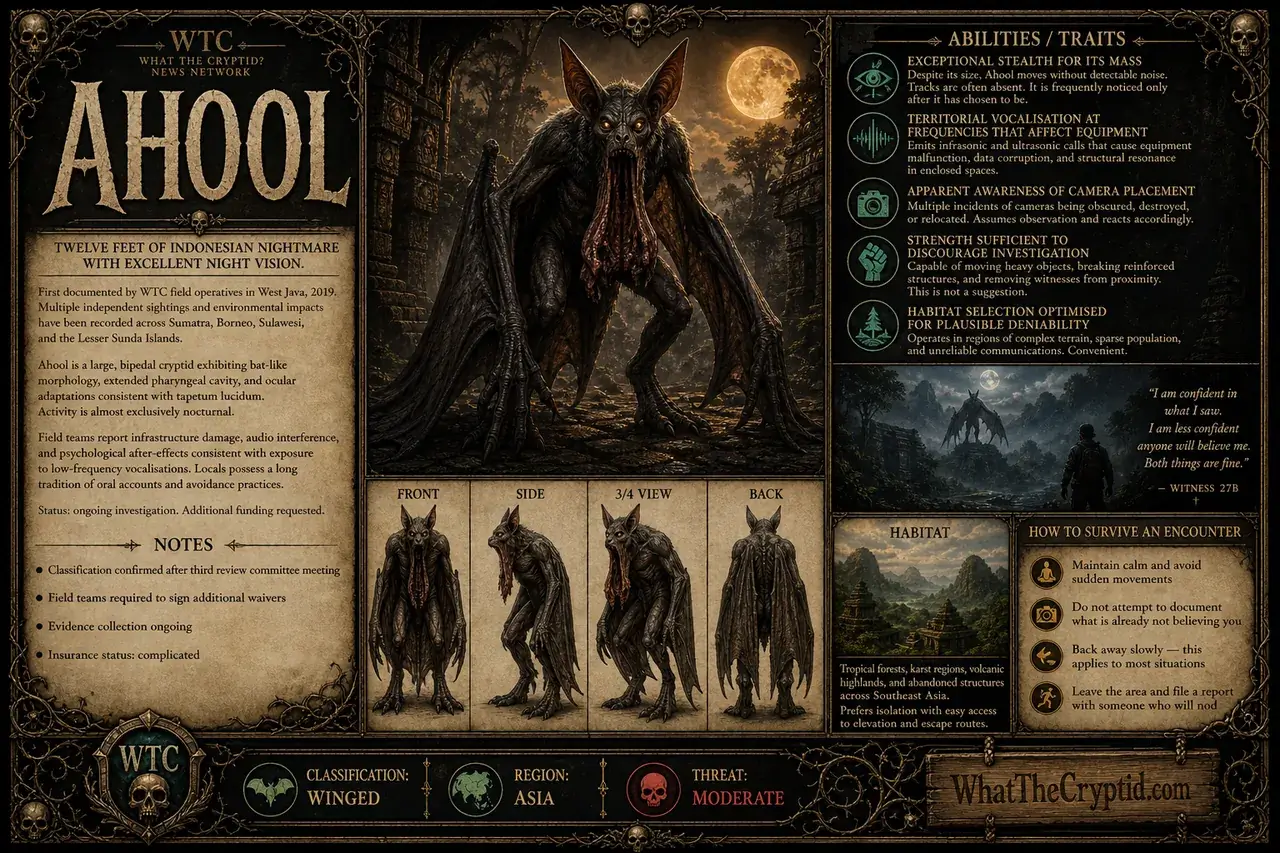
Ahool
Ten-foot wingspan. Documented once. Still out there.
Asia
Unverified
Giant BatJavaIndonesiaWinged Cryptid
Overview
The Ahool is a large, bat-like cryptid reported primarily from the mountainous rainforests of western Java, Indonesia, with occasional accounts extending to Sumatra and mainland Southeast Asia. It is distinguished by its exceptional wingspan, estimated in the most credible field accounts at between 10 and 12 feet tip to tip, and by a vocalisation described uniformly across independent sightings as a descending, resonant cry rendered phonetically as ‘ah-OOL’ — which also, with characteristic efficiency, provides the entity its common name. WTC classifies it as Winged, pending any physical evidence that would invite reclassification into something more alarming.

The entity appears to be nocturnal and has been observed in proximity to rivers and steep-sided ravines, behaviours consistent with echolocation-dependent predators navigating complex terrain. Whether the Ahool uses echolocation has not been confirmed, as no researcher has yet managed to be simultaneously close enough to the animal and composed enough to operate recording equipment. These two conditions have, to date, proven mutually exclusive.
Interest in the Ahool within the cryptozoological community has remained steady since the early twentieth century, sustained by the internal consistency of witness descriptions across decades and cultural groups. This consistency is either compelling evidence of a genuine undiscovered species or evidence of a remarkably stable folk tradition, and WTC researchers have spent considerable time disagreeing about which.
History & Mythology
The earliest formal Western record of the Ahool comes from naturalist Dr. Ernest Bartels, who reported an encounter in 1925 while conducting ornithological fieldwork on the slopes of Mount Salak in West Java. Bartels described a creature of enormous wingspan passing directly overhead at low altitude in the early hours of the morning, close enough that he felt displaced air on his face. He heard its call — the characteristic descending ‘ah-OOL’ — twice before it disappeared into the forest canopy. Bartels was not a man given to fanciful reporting; he had spent years in the field and was, by his own account, extremely reluctant to include the encounter in any official documentation. He eventually did, in 1927, a decision that the scientific community received with the enthusiasm typically reserved for self-inflicted professional complications.
Indigenous Sundanese communities of West Java have maintained accounts of a large bat-like spirit creature for generations prior to Bartels’ documentation, referring to it in terms that describe both a physical animal and something with a less easily categorised nature. Oral traditions collected by Dutch colonial ethnographers in the late nineteenth century describe the creature as an inhabitant of deep river gorges and old-growth forest, active after dark and rarely encountered directly. That these accounts predate Western cryptozoological interest by several decades is noted here without further editorial comment.
Subsequent decades produced additional reports from researchers and travellers in the region, with a notable cluster of accounts in the 1970s corresponding with increased ecotourism access to Javan interior regions. The pattern of sightings — concentrated near fast-moving water, at elevations between 1,000 and 2,500 metres, between the hours of 10pm and 3am — has remained consistent enough that WTC maintains it constitutes genuine locational data rather than coincidence, though this position is not universally shared at editorial meetings.
Physical Description
Witness accounts of the Ahool converge on several physical characteristics with a degree of consistency that WTC considers significant. The wingspan is the most-cited feature, with estimates ranging from 8 to 12 feet across; the most frequently reported figure of approximately 10 feet would make it comfortably the largest bat-like organism on record by a margin that the relevant academic literature prefers not to engage with. The body, where observed, is described as roughly the size of a large dog or small juvenile orangutan, with dark grey or black fur covering the torso and inner wing membranes. The face is described as flat and primate-like rather than elongated in the manner of known bat species, with large, forward-facing eyes that several witnesses have described, unprompted and independently, as red or reddish-orange when caught in light.
The feet are reported as large and clawed, oriented for grasping rather than hanging, which would represent a notable departure from the postural habits of known chiroptera and has led some researchers to propose that the Ahool is not, technically, a bat at all. These researchers have found the alternative taxonomic categories equally unsatisfying, and the question remains open. The wing membrane appears to attach along the body and upper leg in a configuration consistent with microchiropteran anatomy scaled to an improbable size, though no close-range ventral observation has been documented under conditions reliable enough to confirm this.
No regional variants have been formally proposed, though accounts from Sumatra describe an entity with broadly similar characteristics and a slightly different vocalisation, sometimes catalogued separately as a related form. WTC treats these as provisionally the same species until evidence suggests otherwise, primarily for administrative reasons.
Behaviour & Temperament
The Ahool is, by all available accounts, a creature that would strongly prefer not to be documented. It is active exclusively at night, typically observed in flight rather than at rest, and appears to avoid lingering in proximity to humans once visual or auditory contact has been established. This is a behavioural profile that has served it extremely well across at least a century of cryptozoological interest. Sighting durations average between four and fifteen seconds, which is long enough to be memorable and short enough to be useless for photographic purposes.
The creature’s vocalisation — the namesake descending call — has been reported both in flight and, on at least two occasions, from a stationary position in dense canopy, suggesting the call serves communicative functions beyond simple echolocation. Whether these functions include territorial signalling, mating behaviour, or something the existing ethological vocabulary is not fully equipped to describe has not been determined. Witnesses who have heard the call from close range consistently describe it as deeply unpleasant, not in any way that implies aggression, but in the manner of a sound that operates at a frequency the human nervous system registers before the conscious mind has finished processing it.
No aggressive behaviour toward humans has been confirmed, though two accounts describe the Ahool making a close, low pass over a witness before departing — a behaviour that could indicate curiosity, territorial communication, or navigational routine. WTC’s current working assumption is that the Ahool is not interested in humans as prey, a position we intend to maintain until presented with evidence to the contrary.
Habitat & Territory
The Ahool is associated almost exclusively with primary rainforest at elevations between 1,000 and 2,500 metres above sea level, with the strongest concentration of reports centred on the Sundanese highlands of West Java — particularly the watersheds of Mount Salak, Mount Gede, and the Ujung Kulon corridor. The terrain preferred by the entity is consistently described as steep, densely canopied, and threaded with fast-moving rivers and waterfalls, a combination that would provide excellent acoustic conditions for echolocation, abundant prey, and near-total inaccessibility to research teams carrying equipment. The Ahool has chosen its address well.
Roost sites have never been directly observed, which is perhaps the single most important gap in the existing data. Proposed roost locations include cave systems along river gorges, old-growth canopy at ridge level, and rock overhangs behind waterfalls — the last of which is appealing as a hypothesis and essentially impossible to investigate safely. At least three cave systems in the Mount Salak region have been informally identified by local guides as associated with the creature, though none have been formally surveyed for evidence of large-animal occupation, for reasons that vary by account but share a common theme.
Diet & Hunting
The Ahool is presumed to be piscivorous — a fish-eater — based on its documented preference for habitat near fast-moving rivers and on the behavioural observation, recorded in multiple independent accounts, of the creature flying low over water surfaces in a manner consistent with surface-hunting. This would place it in a feeding guild occupied by known species such as the greater fishing bat, Noctilio leprosa, though the Ahool’s scale would imply prey items considerably larger than anything that species pursues. The rivers of the Javan highlands contain mahseer and giant gourami specimens of sufficient size to constitute a plausible dietary staple for an organism of this mass, and WTC notes this without claiming it proves anything.
Whether the Ahool supplements its diet with other protein sources — large insects, birds, small mammals — has not been established from observation. One account, from a researcher who requested anonymity and whose institutional affiliation WTC has agreed not to disclose, describes finding the partial remains of a large river fish on a rock outcropping in the Mount Gede area in a condition suggesting it had been dropped from altitude. The account was submitted with photographs. The photographs were of insufficient resolution to confirm the finding, which the researcher attributed to humidity affecting their lens and which WTC attributes to the general condition of fieldwork in this region.
Notable Sightings
Dr. Ernest Bartels, conducting ornithological survey work on the southern slopes of Mount Salak at approximately 11:40pm, observed a large winged creature pass overhead at an estimated altitude of 15 to 20 feet. Bartels reported feeling displaced air consistent with a large wingspan and heard the descending two-note call twice as the entity moved north toward the river valley below. He estimated the wingspan at no less than 10 feet and noted the flat, primate-like facial profile in the brief moment it was silhouetted against the sky. Bartels documented the encounter in his personal field notes that evening and did not publish a formal account until 1927, a delay he attributed to wanting to be certain he had not been mistaken, which he ultimately concluded he had not.
A ranger stationed at a remote monitoring post in Ujung Kulon reported hearing the Ahool’s characteristic call on three consecutive nights between 1am and 2am, originating from the direction of a river approximately 400 metres north of the post. On the third night, he observed a large dark shape in level flight crossing a gap in the canopy for an estimated duration of six to eight seconds. He described the wingspan as ‘wider than the river,’ which at that location measures approximately 9 metres, though he subsequently qualified this estimate as an impression rather than a measurement. The ranger filed a standard wildlife observation report with park administration, noting the event under the species field as ‘unknown large chiroptera.’ Park administration forwarded the report to the relevant forestry ministry department. No follow-up survey was commissioned.
A group of four ecotourism guides leading a night-walk excursion along the Ciawi River reported an encounter at approximately 12:15am in which a large winged animal made two low passes over the river surface approximately 30 metres ahead of the group before ascending into the canopy. Two of the four guides independently described hearing a sound they compared to large wings displacing air, and all four reported hearing the descending vocalisation on the second pass. The tourists present — a party of six — did not obtain any usable photographs due to the combined challenges of darkness, movement, and, as described in post-trip feedback forms, ‘shock.’ The senior guide, a 22-year veteran of the route, stated afterward that this was not the first time he had witnessed this behaviour on that stretch of river, and that he had long since stopped mentioning it in advance of tours.
A camera trap deployed by a wildlife monitoring NGO at a river crossing at 1,400 metres elevation captured 11 seconds of thermal footage at 2:08am showing a large winged form crossing the frame at low altitude. The footage was reviewed internally and flagged as anomalous; the wingspan as estimated from the frame width and known camera field of view was calculated at between 9.4 and 11.2 feet, with the range reflecting uncertainty in the entity’s exact flight altitude. The footage was submitted to three separate wildlife biologists for assessment. All three provided written responses. All three requested that their names not be associated with the footage in any public documentation. WTC has honoured these requests and is currently in possession of what may be the most significant thermal record of the Ahool obtained to date, which it is not currently able to discuss in full detail for reasons its legal department describes as ‘ongoing.’
Threat Assessment
Direct physical threat from the Ahool to humans is assessed as low under normal field conditions, based on the consistent absence of aggressive behaviour in documented accounts and the entity’s apparent preference for rapid disengagement upon human detection. WTC recommends maintaining a minimum distance of 30 metres if an Ahool is observed in flight, not because this distance is based on any documented attack range, but because it represents the outer limit at which most witnesses have reported experiencing the displaced-air effect from the wingbeats, and because being closer than this when a 10-foot-wingspan nocturnal animal is making low passes over a river at midnight involves a risk profile WTC is not comfortable formally endorsing.
Field teams operating in known habitat are advised to: carry high-lumen headlamps directed upward when moving near water after 10pm; avoid positioning themselves on exposed riverbanks or rock outcroppings during peak activity hours; and maintain auditory awareness for the characteristic descending call, which provides approximately three to eight seconds of approach warning in documented cases. WTC also recommends informing local guides of your research objectives before entering the field, as several have indicated they possess considerable locational knowledge they are prepared to share once they are confident the requesting party understands what it is asking for. It should be noted honestly that all of the above guidance is based on accounts of a creature that no researcher has yet successfully approached at close range under controlled conditions, and that the threat assessment may require revision as better data becomes available.
WTC Field Notes
WTC dispatched a field researcher to West Java in 2021 with the specific objective of deploying acoustic monitoring equipment at three pre-identified river sites in the Gunung Halimun-Salak park system. The equipment deployment was completed successfully. Of the three units installed, two malfunctioned within 72 hours in ways that the manufacturer’s technical support team described as ‘inconsistent with normal environmental failure modes’ and declined to elaborate on further. The third unit recorded 14 nights of audio before its memory card was found to be corrupted on retrieval. Our field researcher returned with a detailed written journal, three rolls of 35mm film in which every frame was correctly exposed and entirely black, and a revised perspective on career choices that she has not yet fully articulated to HR.
The Ahool entry has been in the WTC Cryptid Database queue since the network’s second year of operation and has been drafted, redrafted, and held for legal review on three separate occasions. The current entry represents our fourth attempt at a version that does not prompt letters from institutions whose names appear in the sightings documentation. We have removed two sightings from this edition that appeared in the third draft, not because we doubt their veracity, but because one of the witnesses has since accepted a position at a university whose communications office contacted us within four hours of the previous draft being circulated internally. We remain committed to publishing a complete record when circumstances permit, which our editor describes as ‘eventually.’